
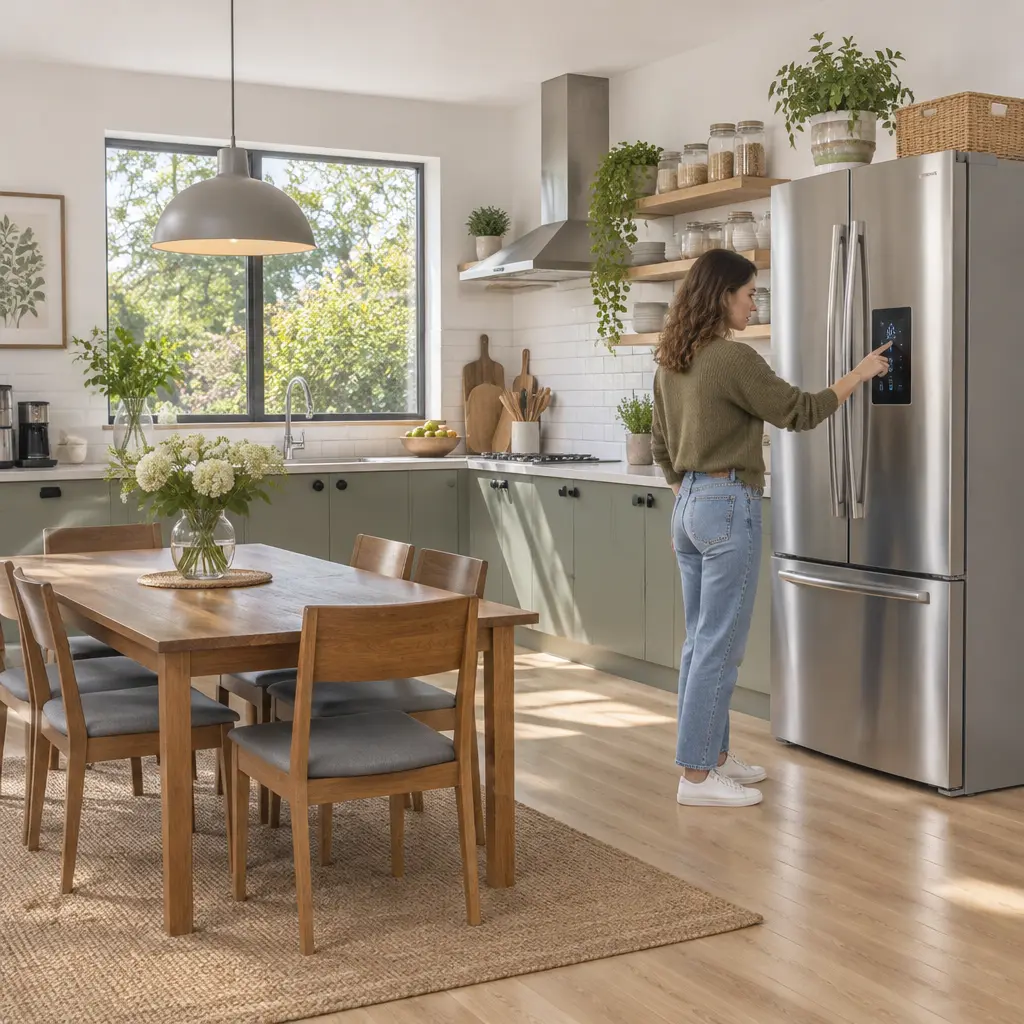
Connected appliances are kitchen devices that use sensors, internet connectivity, or automated controls to help people monitor and manage cooking, food storage, water, and energy use. They can support healthier kitchens by making food-safety checks more visible, helping households plan and prepare meals, and improving awareness of indoor air and resource use—but they are aids, not substitutes for safe handling or medical advice. The need is substantial: the World Health Organization estimates that 600 million people worldwide fall ill and 420,000 die each year after eating contaminated food. This article explains how connected refrigerators, cooking devices, air-quality tools, and water monitors can contribute to healthier routines, what evidence supports their benefits, and what privacy and reliability limits consumers should consider.
Connected appliances improve kitchen health through monitoring and feedback
A connected appliance is a household device that exchanges data with an app, network, or other device, often using sensors to report conditions or automate a task. The U.S. National Institute of Standards and Technology describes the Internet of Things as a network of physical objects with sensors and connectivity that enable them to interact with their environment and exchange data. In kitchens, the category includes smart refrigerators, connected thermometers and ovens, ventilation controls, and some water-quality monitors.
The health value depends on the appliance’s specific function. A temperature alert may help a household notice a refrigerator problem; a probe thermometer can show whether food has reached a safe internal temperature; and a range hood that is used consistently can remove cooking pollutants. Connectivity mainly makes these functions easier to observe, record, or control. It does not guarantee accurate sensors, safe food, clean air, or healthier eating.
The U.S. Food and Drug Administration identifies keeping food at safe temperatures, separating raw and ready-to-eat foods, cleaning, and cooking thoroughly as core food-safety practices. Connected features can reinforce parts of that routine, but the underlying practices remain essential.
Food-safety monitoring: refrigerator and freezer alerts
Food-safety monitoring uses sensors or alerts to help users track storage conditions. FDA guidance recommends keeping a refrigerator at or below 40°F (4°C) and a freezer at 0°F (−18°C). A connected refrigerator may display temperatures, warn users when a door is left open, or send an alert after a power interruption. These notifications can prompt a timely check, especially when food is stored for several days or when a household is away.
An alert is not proof that food is safe. Sensor placement, calibration, and temperature variation within the appliance matter, and a notification may arrive late or fail if the network or service is unavailable. The FDA advises using an appliance thermometer to verify temperatures. After a power outage, the U.S. Department of Agriculture’s Food Safety and Inspection Service says an unopened refrigerator generally keeps food cold for about four hours; decisions about individual foods should follow official outage guidance rather than an app’s reassurance alone.
Connected cooking tools: more reliable doneness checks
Connected cooking tools include probe thermometers, smart ovens, and cookers that report cooking progress or temperature to a phone. Their most important food-safety contribution is helping users measure internal temperature rather than relying on appearance, cooking time, or a preset program. The USDA recommends cooking poultry to 165°F (74°C), ground meats to 160°F (71°C), and whole cuts of beef, pork, lamb, and veal to 145°F (63°C), followed by a three-minute rest.
A probe thermometer can reduce guesswork, but users still need to place it correctly in the thickest part of the food and avoid touching bone. Smart-oven programs may support consistent cooking, yet the displayed oven temperature is not a substitute for checking the food itself. For households preparing meals for older adults, young children, pregnant people, or people with weakened immune systems, careful temperature measurement is especially relevant because foodborne illness can have more serious consequences for these groups.
Connected appliances support healthier cooking environments
Once storage and cooking are addressed, connected controls can also help households manage the air and water conditions in the kitchen. These benefits are conditional: the appliance must be correctly installed, maintained, and used, and its readings should be interpreted within the limits of its sensors.
Smart ventilation and cooking-related air pollution
Smart ventilation uses sensors, schedules, or connected controls to operate a range hood or other exhaust system. Cooking can release particles and gases, while gas burners can emit nitrogen dioxide and other pollutants. The U.S. Environmental Protection Agency notes that indoor concentrations of some pollutants can be higher than outdoor levels, although levels vary with the source, ventilation, building, and cooking method.
A connected hood may remind users to switch on ventilation, adjust fan settings, or continue running the fan after cooking. The practical priority is effective exhaust: a hood that vents outdoors and is used during cooking is generally more useful for removing pollutants than a recirculating hood that returns air to the room. The American Society of Heating, Refrigerating and Air-Conditioning Engineers’ residential ventilation guidance emphasizes kitchen exhaust as a source-control measure. Smart features can support that behavior, but they cannot compensate for an undersized, poorly installed, or unmaintained system.
Water monitoring and filtration reminders
Connected water monitors may track flow, detect leaks, or prompt filter replacement; some systems also report selected water-quality indicators. These functions can support household safety by drawing attention to maintenance and unusual use. However, a device’s reading is meaningful only for the substances it is designed and independently validated to measure. A general-purpose sensor cannot establish that water is free of every contaminant.
The U.S. Environmental Protection Agency recommends checking local drinking-water information and using treatment products certified for the specific contaminant of concern. A connected filter reminder is useful only if the filter is appropriate and replaced according to its instructions. For suspected contamination, households should consult their water utility or public-health authority rather than relying on an appliance dashboard.
Connected appliances can make healthier routines easier to maintain
Healthier kitchen practices are not limited to eliminating hazards; they also include making nutritious meals practical and reducing avoidable waste. Connected features can lower some organizational friction by keeping track of food, simplifying planning, and making cooking more repeatable. Their effect on diet depends on whether the tools fit a household’s needs and whether users act on the information.
Meal planning and food inventory
Smart refrigerator apps and inventory tools can help users record groceries, note expiration dates, and plan meals around available ingredients. This may make it easier to use produce and leftovers before they spoil, while reducing duplicate purchases. The U.S. Department of Agriculture’s Economic Research Service estimates that 30–40% of the U.S. food supply is lost or wasted, though estimates vary by measurement method and stage of the supply chain.
Inventory features are not always automatic or accurate: users may need to enter items, correct quantities, and distinguish best-quality dates from safety guidance. Their strongest contribution is organizational, not nutritional. A meal-planning app can make vegetables, whole grains, or other preferred foods easier to include, but it cannot determine an individual’s dietary needs or ensure a balanced diet.
Automation, accessibility, and consistency
Timers, voice controls, remote operation, and repeatable cooking programs can reduce the number of steps involved in preparing meals. For people with limited mobility, vision, or dexterity, accessible controls and clear alerts may make some kitchen tasks easier. Automated shutoff and reminders can also help users manage cooking more consistently, although products differ in accessibility and safety design.
Automation should be treated as support rather than supervision. Users should follow manufacturer instructions, keep children away from hot surfaces, and avoid remote operation when it could create a hazard. A device’s ability to start or stop a process does not establish that the surrounding conditions are safe.
Connected kitchen health benefits depend on privacy, maintenance, and evidence
Connected appliances collect or transmit information that may include device status, usage patterns, voice commands, or household routines. A healthier kitchen should therefore be evaluated not only by convenience but also by data practices, cybersecurity, repairability, and what happens when the internet or a service provider is unavailable.
Privacy and cybersecurity safeguards
The U.S. Federal Trade Commission advises companies to build security into connected products, limit data collection to what is needed, and provide clear privacy information. Consumers can reduce exposure by changing default passwords, installing security updates, using a separate guest or smart-device network when available, and reviewing app permissions and data-sharing settings. Before buying, check how long software support is expected to continue and whether basic functions still work without an account or cloud connection.
Sensor accuracy, upkeep, and equitable access
Sensors can drift, batteries can fail, filters can clog, and software can stop receiving updates. Routine checks—such as confirming refrigerator temperature with an appliance thermometer and testing a cooking probe against its instructions—help users avoid treating a digital display as infallible. For safety-critical decisions, compare app guidance with recognized public-health recommendations.
Cost and internet access also shape who can benefit. A household does not need a fully connected kitchen to improve food safety or air quality: a basic refrigerator thermometer, a reliable food thermometer, and a properly used exhaust hood can address important risks. Smart features are most valuable when they solve a real problem without adding costs or complexity that outweigh the benefit.
Conclusion: connected appliances are tools for healthier kitchens
Connected appliances can make kitchen conditions and routines easier to monitor. Refrigerator alerts may support safe storage, connected thermometers can help verify cooking temperatures, ventilation controls can encourage pollutant removal, and inventory tools can make meal planning and food use more manageable. These are useful contributions, particularly when they reinforce established food-safety and household-health practices.
The broader lesson is that connectivity is not itself a health benefit: dependable sensors, correct installation, maintenance, privacy protections, and informed use determine whether a feature helps. Start with the kitchen’s most important needs, compare smart features with simple alternatives, and follow guidance from public-health and safety authorities. Further reading from the FDA, USDA, EPA, and FTC can help households make evidence-based choices.
Sources: World Health Organization, Food safety fact sheet, https://www.who.int/news-room/fact-sheets/detail/food-safety; U.S. National Institute of Standards and Technology, Internet of Things (IoT), https://www.nist.gov/internet-things-iot; U.S. Food and Drug Administration, Food Safety at Home, https://www.fda.gov/consumers/free-publications-women/food-safety-home; U.S. Department of Agriculture, Food Safety and Inspection Service, Safe Food Handling, https://www.fsis.usda.gov/food-safety/safe-food-handling-and-preparation; U.S. Department of Agriculture, Food Safety and Inspection Service, Food Safety During Power Outages, https://www.fsis.usda.gov/food-safety/safe-food-handling-and-preparation/emergencies/food-safety-during-power-outage; U.S. Environmental Protection Agency, Introduction to Indoor Air Quality, https://www.epa.gov/indoor-air-quality-iaq/introduction-indoor-air-quality; American Society of Heating, Refrigerating and Air-Conditioning Engineers, ASHRAE Standard 62.2, Ventilation and Acceptable Indoor Air Quality in Residential Buildings, https://www.ashrae.org/technical-resources/bookstore/standard-62-2; U.S. Environmental Protection Agency, Private Drinking Water Wells, https://www.epa.gov/privatewells; U.S. Department of Agriculture, Economic Research Service, Food Loss and Waste, https://www.ers.usda.gov/data-products/food-availability-per-capita-data-system/food-loss; U.S. Federal Trade Commission, Internet of Things: Privacy & Security in a Connected World, https://www.ftc.gov/reports/federal-trade-commission-staff-report-november-2013-internet-things-privacy-security-connected; U.S. Environmental Protection Agency, Consumer Tool for Drinking Water Testing and Drinking Water Treatment, https://www.epa.gov/ground-water-and-drinking-water