
Luxury appliances are high-end household devices designed to combine advanced performance, materials, and controls; they can support healthier living when their features help people prepare nutritious food, manage indoor air, and clean with suitable temperatures and cycles. The opportunity is relevant at scale: the World Health Organization estimated that 2.3 billion people experienced moderate or severe food insecurity in 2023, while the U.S. Environmental Protection Agency notes that people typically spend about 90% of their time indoors. This article examines what health-supportive appliance features can—and cannot—do, from precision cooking and refrigeration to ventilation, water treatment, and laundry, with public-health evidence distinguishing useful tools from marketing claims.
Health-supportive performance defines luxury appliances
“Luxury appliance” is a market description, not a clinical or regulatory category. There is no single public-health definition that certifies an appliance as luxurious or health-promoting. For this article, a health-supportive luxury appliance means a premium kitchen, laundry, or indoor-environment device whose measurable functions can help reduce exposure to a relevant hazard or make a health-supporting routine easier. The distinction matters: a polished finish, app connection, or premium price alone does not demonstrate a health benefit.
The relevant appliance types are related but serve different purposes: cooking appliances influence food preparation; refrigerators and freezers help manage food safety and waste; ventilation and air-cleaning equipment address indoor pollutants; water-treatment devices target specified contaminants; and laundry equipment can support cleaning practices. Benefits depend on correct installation, maintenance, user behavior, and whether the product is suitable for the particular home and hazard.
Precision cooking and nutritious food preparation
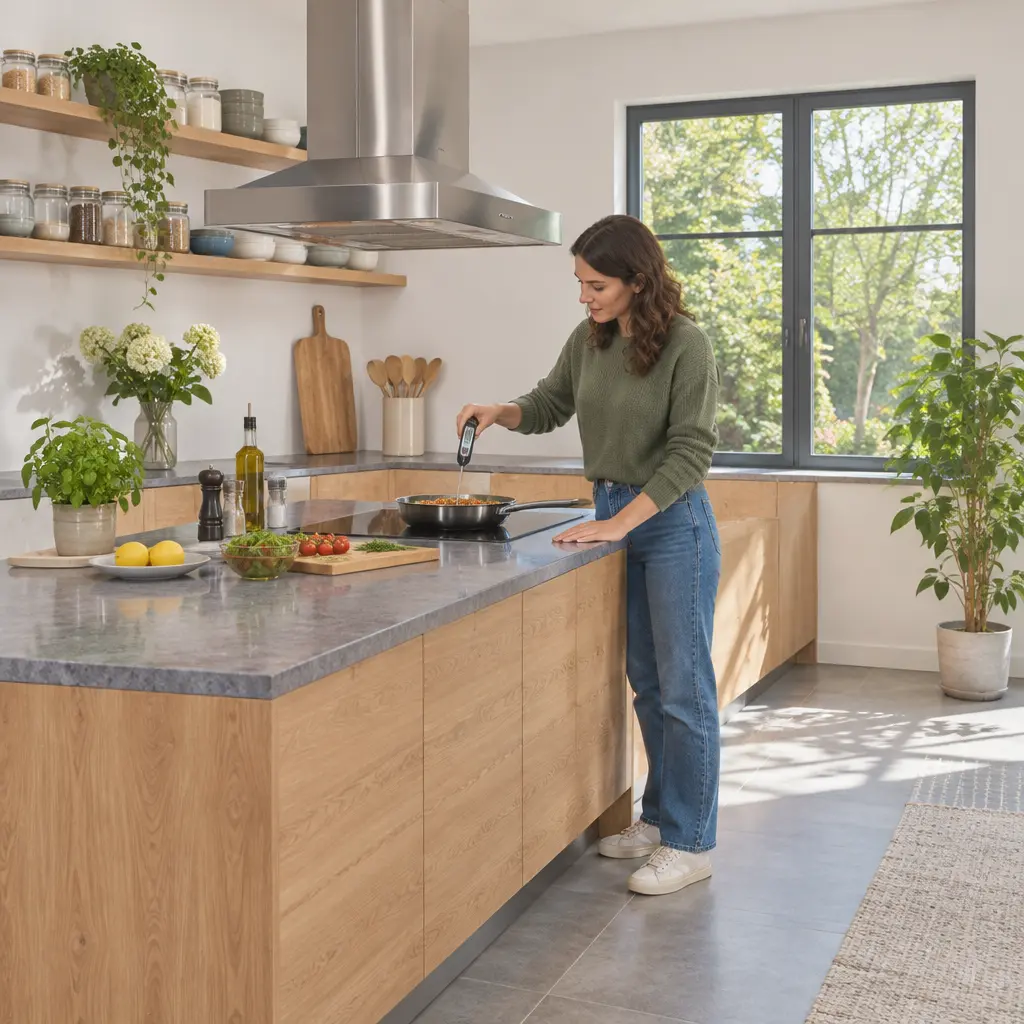
Precision cooking means controlling factors such as temperature, time, and humidity more consistently than an appliance with limited controls may allow. Ovens with accurate temperature settings, steam functions, induction cooktops, and food-temperature probes can make it easier to prepare meals at home and check doneness. These features may support a balanced diet, but the appliance itself does not determine whether a meal is nutritious.
Food safety is a concrete benefit area. The U.S. Department of Agriculture’s Food Safety and Inspection Service advises using a food thermometer because color and texture alone cannot reliably establish that food has reached a safe internal temperature. Its guidance lists, for example, 165°F (74°C) for poultry and leftovers, and 145°F (63°C) followed by a three-minute rest for whole cuts of beef, pork, lamb, and veal. A built-in probe can make checking easier, but users should follow current food-safety guidance and the thermometer manufacturer’s instructions.
Induction cooking is another example of a feature with a plausible health connection. It heats compatible cookware through electromagnetic induction rather than relying on a gas flame. A 2024 study in the journal Science Advances reported that gas and propane stoves can emit benzene, including when not in use, and that emissions can reach other rooms. Induction avoids combustion at the cooktop, although cooking itself can still produce particles and vapors; effective range-hood ventilation remains important regardless of stove type.
Refrigeration, storage, and food safety
Premium refrigeration can offer separate temperature zones, clear temperature displays, humidity management, and alarms for an open door or temperature change. These are useful controls when they help keep perishable food at safe temperatures and make storage conditions visible. The USDA recommends keeping a refrigerator at 40°F (4°C) or below and a freezer at 0°F (-18°C); an appliance display is helpful, but an independent thermometer can verify actual conditions.
Flexible compartments and inventory features may also help households use ingredients before they spoil. This is a practical, indirect health benefit: food that is stored properly and used efficiently can support home meal planning and reduce avoidable waste. Claims such as “preserves nutrients” should be assessed against specific evidence and storage conditions rather than assumed from premium branding.
Food-related features address preparation and storage, but healthier homes also depend on what residents breathe. That makes ventilation and air treatment a separate, closely connected appliance category.
Ventilation and air treatment connect appliances to indoor health
Ventilation is the intentional movement of outdoor and indoor air to dilute or remove pollutants, moisture, and odors. The U.S. Environmental Protection Agency says indoor air can contain pollutants from sources including cooking, cleaning products, building materials, and combustion. Because people spend much of their time indoors, appliance choices that reduce emissions or remove pollutants can matter—but they are not substitutes for source control, adequate ventilation, or professional assessment when a serious problem is suspected.
Range hoods and source capture
A range hood captures cooking emissions near their source and, in a ducted configuration, exhausts them outdoors. The National Institute for Occupational Safety and Health and other public-health authorities emphasize ventilation as a way to reduce exposure to cooking-related pollutants. Hood performance depends on factors including capture area, airflow, duct design, installation, and whether the hood is used. A quiet, high-end hood offers little protection if it is rarely switched on or does not vent effectively.
For households with gas cooking, ventilation is particularly relevant because combustion can add pollutants such as nitrogen dioxide to indoor air. Electric and induction cooktops remove the gas-combustion source at the appliance, but they do not eliminate particles generated by frying, grilling, or other cooking. A practical approach is to use an outdoor-vented hood whenever cooking, choose a suitable cooktop, and maintain filters according to the manufacturer’s directions.
Air purifiers and filtration limits
Portable air cleaners move room air through a filter, often a high-efficiency particulate air (HEPA) filter, to reduce airborne particles. The EPA advises selecting a unit sized for the room and checking its clean air delivery rate (CADR), a measure of the volume of filtered air delivered for specified particle sizes. Filtration can reduce some airborne particles, but it does not remove every gas or vapor; pollutant-specific filters, such as activated carbon, have different capabilities and limited capacity.
Air cleaning is best treated as one layer of protection. The EPA’s guidance prioritizes reducing pollutant sources and improving ventilation where appropriate, with filtration as a supplement. Consumers should be cautious about devices that make broad claims to prevent disease or sterilize an entire home without independent, product-specific evidence.
Indoor-air equipment addresses pollutants in the room; water-treatment appliances instead target substances in drinking water. In both cases, choosing a product should begin with identifying the specific problem rather than selecting by price or feature count.
Water and laundry features support targeted household hygiene
Water filtration and treatment
Water treatment is the use of a process—such as filtration, adsorption, or reverse osmosis—to reduce specified contaminants. A built-in refrigerator filter or premium drinking-water system may improve taste or reduce particular substances, but no single filter removes every contaminant. The U.S. Centers for Disease Control and Prevention recommends choosing treatment based on the contaminant of concern and consulting product certification information; NSF/ANSI standards identify performance claims for defined contaminants rather than certifying that water is universally “pure.”
A useful first step is to check the local water utility’s annual Consumer Confidence Report and, where needed, arrange appropriate testing. Then verify that a treatment unit is certified for the target contaminant and replace cartridges on schedule. A premium dispenser without timely maintenance may not deliver the performance consumers expect.
Laundry temperature, cycles, and maintenance
Laundry appliances can support hygiene through appropriate wash temperatures, cycle selection, and reliable cleaning. Some high-end machines offer sanitizing or allergen-oriented cycles, but results depend on the specific appliance, fabric, load, detergent, and validated operating conditions. “Sanitize” should not be interpreted as a universal guarantee against all pathogens or allergens; users should check the product manual and follow health guidance for items requiring special handling.
Maintenance is part of performance. Cleaning washer dispensers and door seals, allowing the drum to dry when recommended, and cleaning dryer lint filters help keep equipment functioning as intended. These practices are ordinary household hygiene measures, not proof that a particular luxury feature prevents illness.
Choosing appliances by evidence, not prestige
The most useful purchasing decision starts with a household need: safer cooking, lower combustion exposure, better food-temperature control, improved water quality, or a specific air-quality concern. Compare measurable specifications and independent certifications, then consider installation and ongoing costs. A high-end appliance is most likely to support healthier living when its relevant feature is used consistently and maintained properly.
- Identify the health-related goal and the pollutant, food-safety issue, or routine involved.
- Look for verifiable performance data, recognized certifications, and clear operating instructions.
- Account for installation, ventilation, compatible supplies, filter changes, and service needs.
- Use public-health guidance for the underlying issue rather than relying on broad marketing language.
A useful visual for readers would be a comparison chart mapping appliance category to its supported benefit, evidence source, and key limitation—for example, induction cooktops and reduced combustion emissions, thermometer-equipped ovens and temperature verification, or air cleaners and particle filtration.
Conclusion: luxury appliances can enable healthier routines
Luxury appliances support healthier living through specific, practical functions—not through price or appearance alone. Precision cooking and refrigeration can assist with food preparation and safe storage; induction and effective range hoods can reduce exposure to combustion-related pollutants; air cleaners can filter some particles; and certified water treatment and suitable laundry cycles can address narrower household needs. Across all categories, outcomes depend on proper selection, installation, use, and maintenance.
Before upgrading, identify the health concern, consult relevant public-health guidance, and compare independently verifiable performance claims. Further reading from the EPA, USDA, CDC, and local water utilities can help households make decisions grounded in evidence rather than prestige.
Sources: World Health Organization, “The State of Food Security and Nutrition in the World 2024,” https://www.who.int/publications/i/item/9789240094419; U.S. Environmental Protection Agency, “Introduction to Indoor Air Quality,” https://www.epa.gov/indoor-air-quality-iaq/introduction-indoor-air-quality; U.S. Department of Agriculture, Food Safety and Inspection Service, “Safe Minimum Internal Temperature Chart,” https://www.fsis.usda.gov/food-safety/safe-food-handling-and-preparation/food-safety-basics/safe-temperature-chart; U.S. Department of Agriculture, Food Safety and Inspection Service, “Refrigeration and Food Safety,” https://www.fsis.usda.gov/food-safety/safe-food-handling-and-preparation/food-safety-basics/refrigeration; Kashtan et al., “Gas and Propane Combustion from Stoves Emits Benzene and Increases Indoor Air Pollution,” Science Advances, 2024, https://www.science.org/doi/10.1126/sciadv.adm868из; U.S. Environmental Protection Agency, “Air Cleaners and Air Filters in the Home,” https://www.epa.gov/indoor-air-quality-iaq/air-cleaners-and-air-filters-home; U.S. Centers for Disease Control and Prevention, “About Home Water Treatment Systems,” https://www.cdc.gov/drinking-water/about/about-home-water-treatment-systems.html; National Sanitation Foundation, “Water Filters,” https://www.nsf.org/consumer-resources/articles/water-filters.