
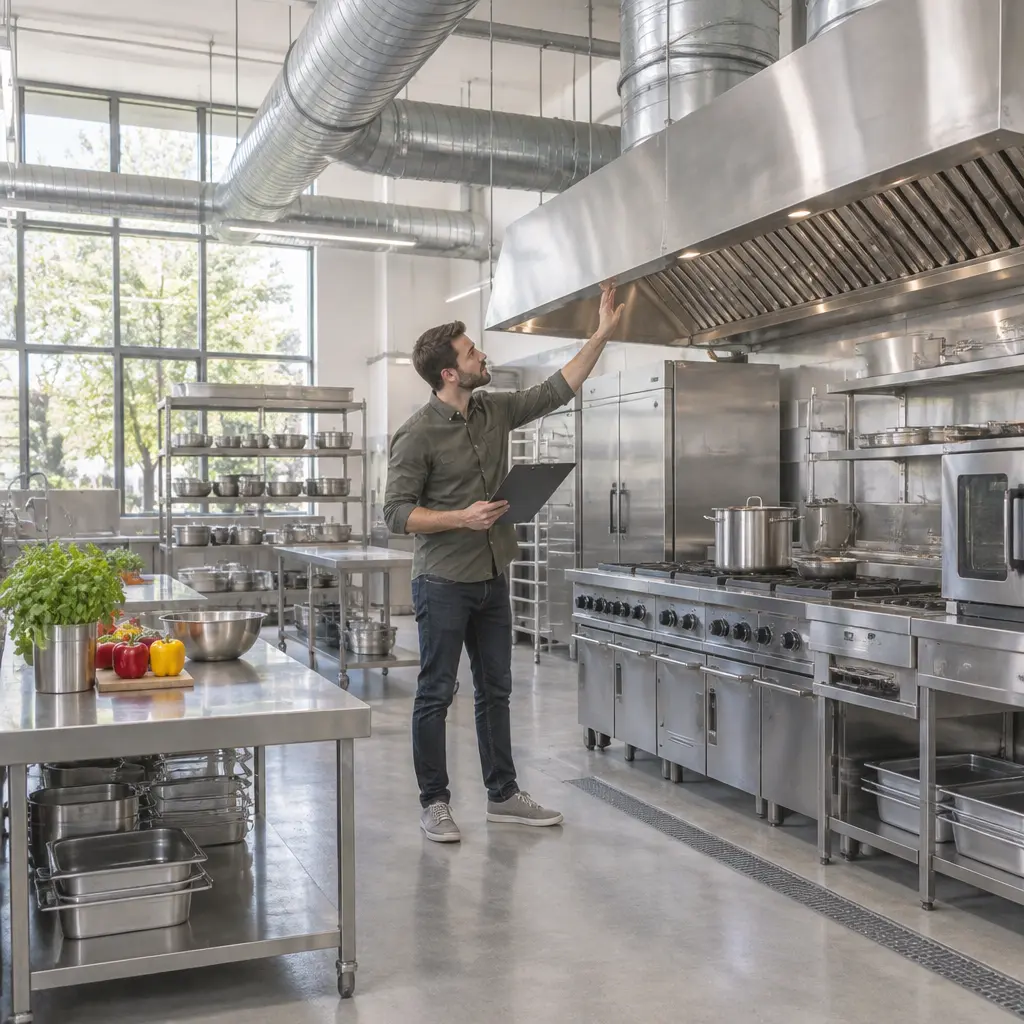
Commercial kitchen ventilation sizing is the process of determining how much air a hood must capture and exhaust to manage heat, smoke, grease, and cooking contaminants. The accurate approach is to size ventilation for the actual cooking equipment, duty, hood configuration, and operating conditions—not simply to select a fan by kitchen area or equipment nameplate power. ASHRAE guidance and the International Mechanical Code (IMC) distinguish among hood types and cooking duty, while field testing and commissioning help confirm that a system captures emissions without excessive energy use or disruptive drafts. This guide explains how to classify cooking output, estimate exhaust, account for makeup air and building pressure, and validate performance in practice.
Cooking-duty classification determines ventilation sizing
Cooking-duty classification is the assignment of equipment and processes to categories such as light, medium, heavy, or extra-heavy duty so designers can select an appropriate hood and exhaust approach. The IMC defines these categories by the heat and effluent produced by cooking operations; the exact classification and required exhaust rate depend on the adopted code edition, hood listing, equipment arrangement, and local amendments. ASHRAE’s kitchen-ventilation guidance likewise emphasizes matching exhaust to the cooking process and hood, rather than treating all appliances alike.
This distinction matters because a low-emission oven and a charbroiler can have very different plume behavior even when their rated electrical or fuel input appears similar. A hood serving high-output equipment must capture rising heat and grease-laden effluent under real operating conditions. Conversely, oversizing every system can increase fan energy, heating and cooling loads, noise, and the volume of replacement air required.
Light- and medium-duty equipment
Light-duty equipment typically produces comparatively modest heat and little grease-laden effluent; examples may include some ovens, steamers, and kettles, depending on the specific appliance and code definitions. Medium-duty processes produce more heat or cooking effluent and may include ranges, griddles, and certain fryers. These are examples, not universal classifications: designers should verify each appliance against the locally adopted IMC, manufacturer documentation, and authority having jurisdiction.
The practical implication is that a menu change can alter ventilation needs without changing the kitchen footprint. Replacing a steamer with a fryer, for example, may change the required hood arrangement, exhaust capacity, fire-protection provisions, and commissioning criteria. Equipment schedules should therefore identify the actual appliance, fuel or power source, duty classification, and expected simultaneous use.
Heavy- and extra-heavy-duty equipment
Heavy- and extra-heavy-duty equipment generates substantial heat, smoke, grease, or combustion products. Charbroilers, solid-fuel cooking, and high-intensity cooking processes are common examples, although final classification must follow the applicable code and equipment listing. These appliances may require a listed Type I hood, suitable grease filtration, fire suppression, and exhaust ductwork designed for grease-laden air.
High-output appliances can create strong thermal plumes and intermittent surges when food is loaded, doors open, or burners reach peak operation. A sizing calculation based only on average output may miss these demanding conditions. Designers should evaluate the highest credible operating combination and confirm that the hood’s listed configuration and installed clearances match the equipment line.
Hood geometry and capture performance set the required exhaust
Hood capture and containment describe the ability of a hood to draw cooking effluent into the exhaust system and keep it from escaping into the occupied kitchen. The required airflow is affected by hood style, appliance duty, overhang, mounting height, cross-drafts, and whether the hood is wall-mounted or island-mounted. ASHRAE’s kitchen-ventilation guidance and the U.S. Department of Energy’s Better Buildings resources stress that effective system performance depends on the hood and its airflow working together.
There is no single exhaust rate that reliably fits every high-performance cooking line. Code tables, listed hood specifications, and manufacturer engineering data provide the starting point; capture-and-containment testing provides evidence that the installed system works. A design should not reduce airflow below a code or listing requirement simply because a fan appears powerful or the hood looks large.
Hood type, overhang, and mounting height
A wall-mounted canopy is generally positioned against a wall, which helps constrain the plume on one side. An island canopy is exposed to room air on multiple sides and can be more vulnerable to cross-drafts and plume escape. Proximity and backshelf hoods sit closer to appliances and may use different capture principles. The hood’s listing and installation instructions govern allowable appliance relationships, clearances, and airflow.
Overhang—the distance the hood extends beyond the cooking surface—helps capture plumes that spread as they rise. Greater mounting height can allow plume expansion and increase sensitivity to drafts. Designers should coordinate hood dimensions and height with the equipment line, ceiling conditions, lights, sprinklers, and service access rather than treating the hood as a late-stage architectural accessory.
Exhaust airflow and capture verification
Exhaust airflow is commonly expressed in cubic feet per minute (cfm) in U.S. practice. A code-prescribed or listed rate may be expressed by hood length, hood area, or appliance duty, depending on the governing method. The design calculation should record the adopted method and assumptions, including equipment operation, hood configuration, and any approved demand-control strategy.
Commissioning should test the system with representative cooking conditions, not merely confirm that the fan turns on. A qualified technician can measure airflow, inspect filters and duct paths, check fan rotation and speed, and observe capture at the hood perimeter. Smoke visualization can help reveal escape and cross-draft problems, but it should be interpreted by trained personnel and used alongside measured airflow and applicable code requirements.
Makeup air and pressure balance complete ventilation sizing
Makeup air is outdoor or transfer air supplied to replace air removed by kitchen exhaust. A high-capacity hood cannot operate as intended if the building cannot supply replacement air without excessive negative pressure, backdrafting, or uncomfortable drafts. The IMC requires mechanical makeup air for commercial kitchen exhaust systems under specified conditions; the applicable edition and local amendments should be checked for the exact provisions.
The goal is not simply to replace every exhaust cfm directly at the hood. Supply location, air temperature, velocity, and distribution affect capture. Poorly directed supply air can push cooking plumes out of the hood, while inadequate replacement air can make doors difficult to open or interfere with combustion appliances. The system must be balanced as a whole, including general exhaust, toilet exhaust, HVAC supply, and adjacent spaces.
Replacement-air distribution and drafts
Replacement air may be introduced through a dedicated makeup-air unit, conditioned HVAC supply, transfer openings, or a combination allowed by code and design. Discharge should avoid high-velocity jets across the hood face and cooking line. The location and quantity of supply air should be coordinated with hood performance and staff comfort.
A useful design review asks whether the kitchen remains slightly negative relative to adjoining clean spaces while avoiding excessive depressurization. The required pressure relationship varies by building and code; it should be established by the mechanical engineer and verified during balancing. Pressure readings and door operation can identify problems, but they do not replace airflow measurement or capture testing.
Demand-controlled kitchen ventilation
Demand-controlled kitchen ventilation (DCKV) adjusts exhaust and often makeup air in response to cooking activity, using sensors such as temperature or optical plume detection. When properly designed, listed, and commissioned, DCKV can reduce fan operation during lower-demand periods while maintaining required capture at high output. The U.S. Department of Energy’s Better Buildings resources identify demand control as an energy-efficiency opportunity for commercial kitchens.
Savings are project-specific and depend on operating schedules, sensor strategy, fan controls, and the interaction between exhaust and makeup-air systems. DCKV should not be treated as a substitute for correct hood sizing or code compliance. The system must return to adequate airflow when cooking demand rises, and its control sequence should be tested at both minimum and maximum operating conditions.
A practical sizing and validation workflow
A reliable sizing workflow links equipment data, code requirements, hood selection, airflow calculations, makeup-air design, and field verification. Early coordination reduces the risk of costly changes after the hood, ductwork, and kitchen equipment are installed.
- Inventory every appliance, including model, fuel or electrical input, cooking process, duty classification, and anticipated simultaneous use.
- Confirm the locally adopted mechanical and fire codes, hood listing, manufacturer instructions, and authority-having-jurisdiction requirements.
- Select the hood type and dimensions to suit the equipment line, mounting conditions, required clearances, and expected plume behavior.
- Determine exhaust airflow using the approved code, listing, or manufacturer method, documenting assumptions and any diversity or demand-control strategy.
- Design makeup air and HVAC coordination so replacement air does not disrupt hood capture or create excessive building pressure differences.
- Commission the installed system by measuring airflow and checking capture under representative cooking conditions; correct deficiencies before handover.
For example, a restaurant that adds a charbroiler to an existing line should not assume the original hood fan remains adequate because the appliance fits beneath the canopy. The change can affect duty classification, grease loading, fire protection, exhaust requirements, and makeup-air balance. A review by a qualified mechanical engineer and the local code official can identify required upgrades before operation.
Conclusion: Match ventilation capacity to real cooking output
Accurate ventilation sizing begins with cooking-duty classification, then accounts for hood geometry, exhaust airflow, makeup air, pressure balance, and field-tested capture. High-performance appliances make these steps especially important because heat and effluent can rise sharply during peak cooking. A code-compliant calculation is essential, but measurements and representative operating tests show whether the installed system performs as intended.
Before changing a menu or replacing equipment, have the hood, exhaust, makeup-air, and fire-protection systems reviewed together. Consult the adopted code, listed hood documentation, and a qualified ventilation professional; then document commissioning results so future operators can maintain safe, efficient performance.
Sources: International Code Council, 2021 International Mechanical Code, https://codes.iccsafe.org/content/IMC2021P1; ASHRAE, 2021 ASHRAE Handbook—Fundamentals, Chapter 16: Ventilation and Infiltration, https://www.ashrae.org/technical-resources/ashrae-handbook; U.S. Department of Energy, Better Buildings, Commercial Kitchen Ventilation, https://betterbuildingssolutioncenter.energy.gov/accelerators/food-service; U.S. Environmental Protection Agency, ENERGY STAR, Commercial Kitchen Equipment, https://www.energystar.gov/products/commercial_food_service_equipment